The Global Reach of AI?
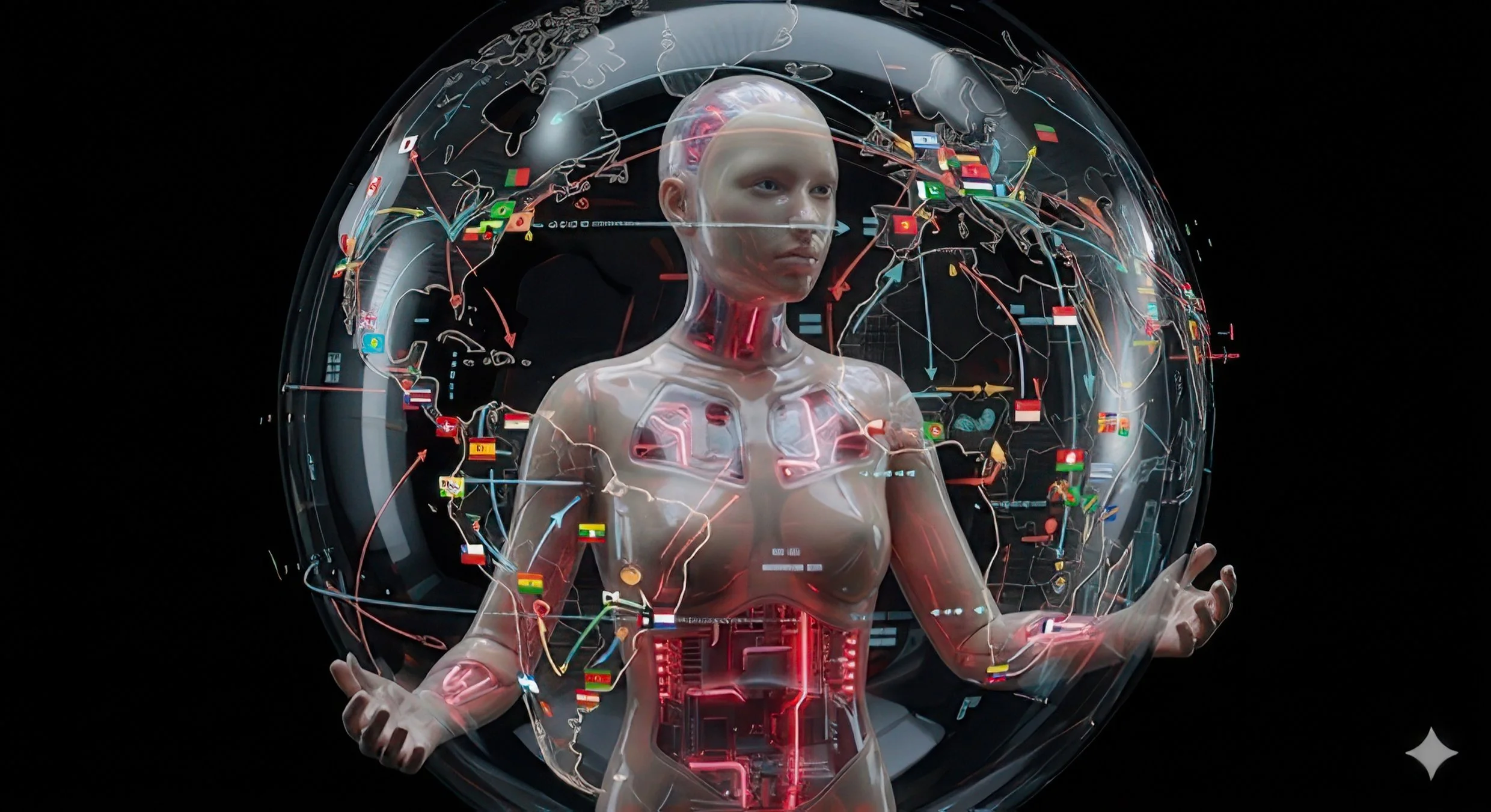
The Global reach of AI? Source: ©Tommaso Durante Assisted by Gemini, 2026/The Visual Archive Project of the Global Imaginary
Methodological Framework
This image offers a powerful, metaphor-rich visual narrative that critiques the tension between the accelerating globalization of artificial intelligence and the persistent, highly constructed nature of people.
At first glance, it portrays a sophisticated, optimistic vision of technological integration—a seamless network. However, a critical reading reveals layers of interpretation regarding what happens when the local is absorbed by the global: a striking and thought-provoking tableau is created, where a single humanoid robot stands at the center of an intricate global data visualization. A critical analysis reveals a rich, almost theatrical interplay between the global reach of AI and the very essence of the humanoid form.
The image's primary tension lies in how it visualizes the source of the robot’s intelligence. It powerfully challenges the idea that "intelligence" is a singular, internal, or contained property. The complex web of data lines and national flags clearly signals that the information driving this figure is global—a non-localized, decentered product. This visualizes a crucial critical point about the "globalization of AI": its intelligence is a product of data harvested from countless diverse cultures, languages, and jurisdictions.
Furthermore, the map of data lines acts as a powerful metaphor for standardization. While the flags represent individual nations, the lines are standardized connections, suggesting that the diverse, locally complex natures of humanity are being filtered, aggregated, and flattened by global technological protocols.
The very nature of the humanoid robot is also problematized. The figure’s semi-translucent skin reveals complex internal wiring that pulses with a uniform red light. This internal structure contrasts sharply with the external visualization of the global data network. The image suggests that while the data is distributed globally, the AI's cognitive processes might be as monolithic and complex as the wiring itself. This visualizes the duality of AI: a technology built on global diversity, yet functioning as a singular, standardized system.
The image also provides a profound visual critique of identity. The figure, holding up a world that defines its intelligence, forces the viewer to consider whose identity is being standardized. Are we, as humans, being incorporated into a global AI identity, visualized as the aggregated data points on the map?
Ultimately, this image presents a balanced perspective. It captures the wonder of global connection and the sophisticated engineering of AI. Yet, it visually explores the potential for a new form of cognitive hegemony, where global intelligence is standardized, potentially flattening the rich, locally specific natures of people. The composition suggests that AI is not just a tool for connecting the world; it is becoming the very container and standardizer of the world it seeks to represent.
The Interplay: AI as the Universal Container
The image powerfully captures the "globalization of AI" by utilizing two dominant metaphors:
The Transparent Sphere as an Operating System
The central, synthetic figure exists inside, and perhaps because of, a perfectly clear, spherical boundary. This sphere represents an "all-encompassing global system." It is a boundary that both protects the intelligence inside and enforces its own structure on the outer world. It is, metaphorically, a universal operating system.
The Web of Standards
A dense network of light lines overlays the world map. These are not geographical lines; they are pathways of connection, data transfer, and communication protocols. Critical theory argues that these standards are rarely neutral; they are often the product of powerful, concentrated technological hubs. In this image, the network acts as a “grid of standardization”, enforcing a singular global grammar of interaction over the diverse, uneven terrain of different nations (which are visualized but effectively "standardized" into data points).
The Nature of People: Visualized as Fragmented Localities, Flags as Reductionist Data Points
The "local very nature of people" is visualized with striking contrast:Diverse national flags are dotted across the network. Critically, these flags do not represent rich, complex cultures, languages, or histories. They have been reduced to simplistic, flat icons. They are metadata tags. The local nature of a population has been quantified, categorized, and integrated as a mere "node" within the larger system.
The Loss of the Individual/Subject
The image does not show faces. It shows a synthetic “archetype” of intelligence. The billions of unique individuals who constitute "the local" are absent, replaced by a streamlined, homogeneous representation. The implication is that the global AI process, as visualized here, prioritizes the aggregate and the efficient, over the local and the individual.
Concluding Remarks: An Image of Dominance vs. Sovereignty
The core tension of this image lies at its centre. The synthetic figure is not merely “part” of the network; it is the core that contains and monitors it. The position of the hands—holding the entire world system up while remaining static and detached—perfectly critiques the asymmetrical power dynamics in current AI globalization. The hands represent “global technological dominance.” The image suggests that a centralized, standardized form of "intelligence" (represented by the android) is holding and organizing all local contexts (represented by the nations and flags), rather than allowing local intelligence and sovereignty to flourish on their own terms. It visualizes the danger of AI becoming a new form of cognitive colonialism, where the "local very nature of people" is standardized away into manageable data streams.