Tommaso Durante’s Global Imaginary: From Neoliberal to Algorithmic
Introduction
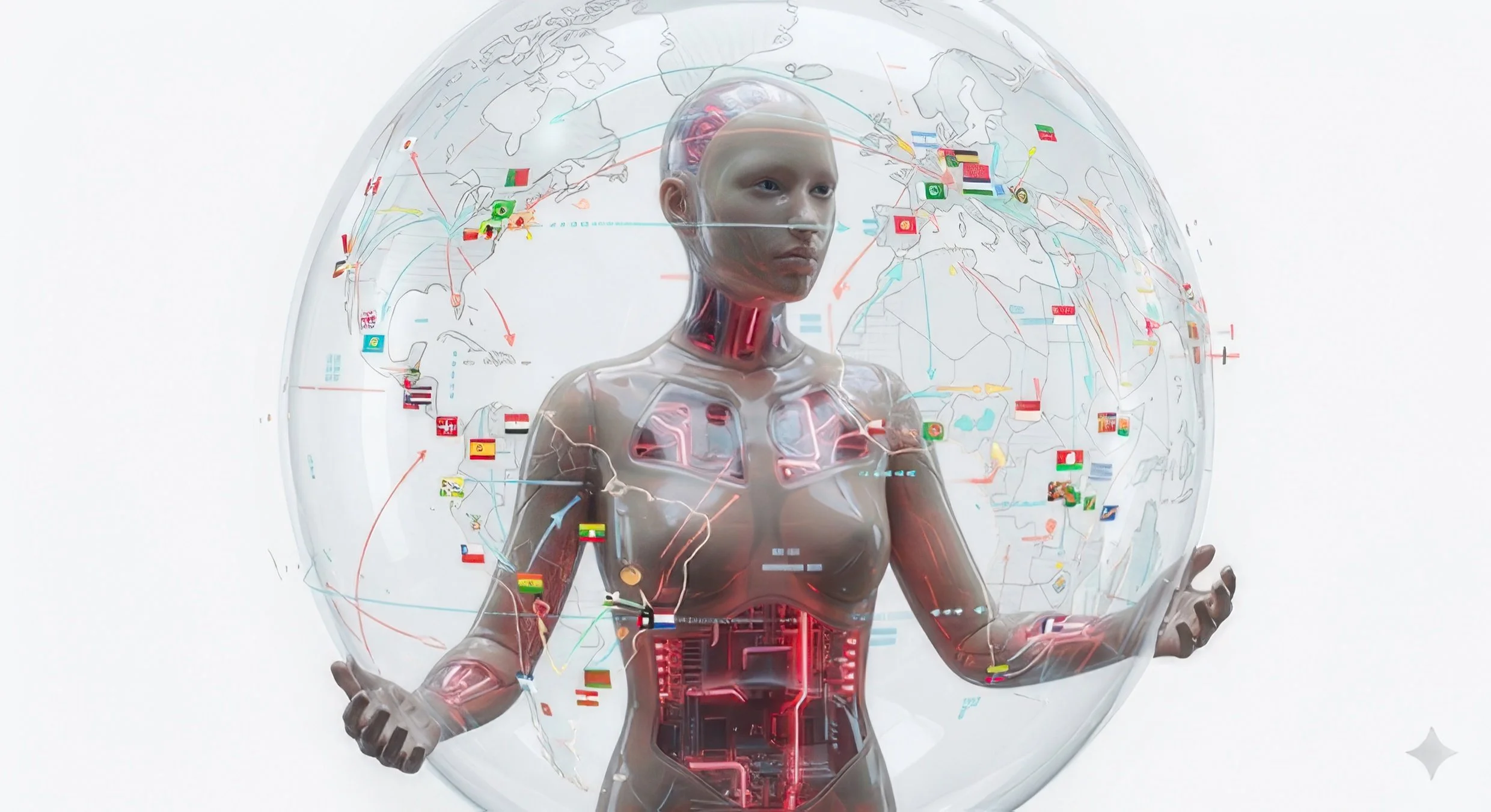
Tommaso Durante’s theoretical framework of the ‘global imaginary’ offers a sophisticated genealogy of how dominant imaginaries shape global media culture. His work traces a significant epistemic and ideological shift: from a neoliberal global imaginary — rooted in the logic of market globalism, free flows of capital, and a borderless world — toward what he terms an algorithmic (or techno-symbolic) global imaginary, animated by the logics of datafication, platformization, and computational governance. This transition is not merely technological but profoundly ideological, restructuring how meaning, identity, and power are produced and circulated at a global scale.
Durante’s research is grounded in the legacies of key thinkers on the image, including Benjamin, Warburg, Panofsky, Riegl, Wickhoff, Wölfflin, Mitchell, Boehm, Belting, and others, and examines how their approaches continue to inform contemporary scholarship on visual culture. The Visual Archive Project of the Global Imaginary collects a limited number of examples of a new class of images (new figures of knowledge)identified as ‘visual-ideological markers of globality’ that pack complex ideological meanings into a single visual construct. These cultural objects serve as a bridge between the local and the global, showing how people worldwide, in their everyday lives, are beginning to share, consciously and unconsciously, a global consciousness.
Examples of Global Icons in Durante's Research
Durante identifies several categories of images that shape our modern world:
Commercial and Corporate Logos: He tracks the presence of the Apple logo and Pepsi Max symbols in diverse urban landscapes, from historic buildings in Rome to glass skyscrapers in Shanghai. These icons represent a ‘global media order’ that overwrites local aesthetics.
Political and Social Movements: He analyzes visual slogans like "We are the 99%" from the Occupy Wall Street movement. He notes that these images spread via digital media, becoming global templates for resistance and appearing in cities as far apart as Washington, D.C., and Santiago, Chile.
Architectural Landmarks: Durante examines how buildings, such as the Shanghai International Convention Center, use ‘global’ motifs (like giant glass globes representing the Earth) to signal a city’s status as a "global city," blending national pride with international ambition. Subversive Art: He discusses Banksy’s ‘David as a Suicide Bomber’ (a replica of Michelangelo’s David with an explosive vest). This icon recontextualizes a classic Western symbol to address contemporary global anxieties regarding terrorism and security. Global Events: Images of the FIFA World Cup or state visits (like Queen Elizabeth II in Melbourne) are studied as moments where the ‘local-national’ is temporarily integrated into a massive, globalized visual performance.
1. The (Neoliberal) Global Imaginary
Durante’s earlier theoretical work, particularly in the global imaginary as a visual-ideological dimension and associated essays, theorizes the global imaginary as a symbolic architecture — a shared horizon of meaning through which social actors make sense of the world. Drawing on the notion of the “modern social imaginary” (Anderson, 1983; Steger, 2008; and Taylor, 2007), Durante argues that neoliberal globalization produced a dominant ideological formation that:
Posited the market as a universal organizing principle of social life;
Celebrated hybridity, flow, and interconnection as emancipatory forces;
Constructed a cosmopolitan, deterritorialized subject — the global consumer-citizen;
Operated through media culture as a soft ideological apparatus, naturalizing market rationality.
This collective (social) imaginary was sustained by what Durante defines as the self-referential system through which global media industries produced narratives about globalization itself, rendering it both inevitable and desirable. Crucially, Durante draws on and expands Stuart Hall’s (1980) encoding/decoding framework and Antonio Gramsci’s concept of cultural hegemony and common sense (of the global) to argue that this was not a top-down imposition but a contested hegemonic formation, reproduced through consent as much as coercion. The neoliberal imaginary was, in essence, a symbolic economy of promise: open markets, open borders, open communication — the utopia of frictionless global connectivity. Scholars such as Arjun Appadurai (1996), in his theory of global scapes, similarly identified how imagination itself became a social practice under globalization, though Durante is more explicitly attentive to the ideological and visual work (consciously and unconsciously) performed by this imagination.
2. Crisis and Transition: The Conditions of Possibility for a New Imaginary
Durante’s more recent work — including essays published in journals such as Fudan Journal of the Humanities and Social Sciences(2026)— identifies a structural crisis of the neoliberal imaginary from the late 2000s onward, precipitated by:
The 2008 global financial crisis, which delegitimized market universalism;
The rise of digital platforms (Google, Meta, Amazon, Apple, Alibaba, Tencent), which reorganized global media culture around new infrastructural logics;
The emergence of big data, machine learning, and algorithmic governance as the dominant organizational forms of late capitalism;
Growing geopolitical fragmentation and the return of nationalist discourses, undermining the cosmopolitan promise.
Neoliberalism did not collapse; it transformed, embedding itself within new technological manifestations. Durante’s contribution is to theorize this transformation at the level of the social (collective) imaginary — that is, at the level of symbolic and cultural-ideological reproduction.
3. The Algorithmic (Techno-Symbolic) Global Imaginary
Durante’s concept of the algorithmic global imaginary — developed across his more recent theoretical writings — represents a qualitative break from, yet structural continuity with, the neoliberal formation. It is “global” in that it operates transnationally, but its logic is no longer primarily that of the market but of the algorithm — the computational sorting, ranking, predicting, and optimizing of human life.
3.1 Key Features
a) Algorithmic IdeologyDrawing on Christian Fuchs (2017), Robert Hassan (2020), James H. Mittelman (2023, 2026), Matteo Pasquinelli (2015), and Langdon Winner (1980) Durante argues that algorithms are not neutral tools but carry an ideology: they operationalize particular assumptions about value, relevance, normality, and desirability, while rendering those assumptions invisible beneath a veneer of technical objectivity. This is what Durante, drawing on and expanding Mager’s notion (2012) of how capitalistic society shapes search engines, calls the “algorithmic ideology” — a successor formation to neoliberal ideology that governs through code rather than (or in addition to) discourse.
b) The Techno-Symbolic Order
The concept of the techno-symbolic is central to Durante’s framework. It captures the way in which digital platforms are simultaneously technical infrastructures and symbolic environments — they do not merely transmit meaning but actively produce and curate it through recommendation systems, content moderation, search rankings, and data-driven personalization.
c) From Flow to Filter
Whereas the neoliberal imaginary valorized flow — the free movement of capital, people, images, and ideas — the algorithmic imaginary is organized around filtering. The dominant metaphor is no longer the open market or the global village but the feed, the platform, and the personalized bubble. This represents a profound restructuring of the global symbolic space: rather than a shared cosmopolitan culture, we get algorithmically differentiated micro-publics. Eli Pariser’s (2011) concept of the “filter bubble,” while empirically contested, gestures toward the same cultural logic.
d) Subjectification and the Data Subject
The neoliberal imaginary produced the entrepreneurial self (Foucault, 2008; Brown, 2015). The algorithmic imaginary, Durante argues, produces a different subject: the data subject — one whose identity, desires, and behaviors are continuously tracked, profiled, predicted, and nudged. This is consistent with Shoshana Zuboff’s (2019) theorization of “surveillance capitalism,” though Durante’s framework is more attentive to the cultural and imaginary dimensions of this subjectification, not merely its economic logic.
e) Technological Solutionism as Ideological Horizon
In the algorithmic imaginary, the promise of salvation — previously attached to the free market — is now displaced onto technology itself. Evgeny Morozov’s (2013) critique of technological solutionism is instructive here: complex social and political problems are reframed as computational problems amenable to data-driven solutions, depoliticizing social life in new ways.
4. The Visual-Ideological Dimension of the Algorithmic Global Imaginary
4.1 Situating the Problematic
The question of how globalization is imagined, symbolically mediated, and ideologically reproduced has occupied global studies scholars for several decades. Yet for much of this period, as Tommaso Durante (2016) argues, the field has suffered from a conspicuous lacuna: a “dearth of scholarship investigating the link among ‘social imaginary,’ ideology, and these new figures of knowledge of the global” that shape everyday life. Durante’s intellectual project, beginning with The Visual Archive Project of the Global Imaginary (2007–ongoing) and culminating most recently in his 2026 Springer article Digital (Global) Capitalism and Re-Globalization, represents a sustained attempt to correct this absence. His contribution is not merely additive; it is paradigm-challenging. He insists that to better understand globalization as a material and ideational process, one cannot disregard investigating its “visual-ideological” dimension. In the most recent iteration of his framework, this visual-ideological lens is extended to encompass what he calls the algorithmic global imaginary — a concept that dramatically reconfigures earlier theorizations of the global imaginary in light of digital capitalism, AI-driven platforms, and what he terms algorithmic ideology.
4.2 What The Project Inherits and Critiques
Benedict Anderson and the National Imagined Community
The genealogy of Durante’s project begins with Benedict Anderson’s Imagined Communities (1983) in which the nation is understood as a culturally constructed, symbolically mediated community held together through shared print media and representational practices. Anderson’s argument that communities are fundamentally imagined — real in their social effects but constructed through discourse and images — provides the ontological scaffolding for all subsequent imaginary theory. However, for Durante, Anderson’s framework is necessarily limited because it is scaled to the nation-state, unable to account for the transnational and planetary dimensions of contemporary symbolic production (Durante, 2013, 2016, 2018).
Charles Taylor and the Modern Social Imaginary
Charles Taylor’s Modern Social Imaginaries (2004) deepened the philosophical account by understanding the social imaginary not as theory or doctrine but as the practical, affective, and largely pre-reflective background through which people understand the basic features of their social existence. Taylor distinguished the social imaginary from formal ideology by emphasizing its embeddedness in everyday moral orders, images, and narratives. For Durante, Taylor’s framework is invaluable but insufficiently attentive to the visual and ideological mechanisms through which imaginaries are reproduced. Taylor’s account remains largely discursive and philosophical, undertheorizing the role of material images circulating in urban and media environments in constituting the imaginary itself.
Manfred Steger and the Rise of the Global Imaginary
Durante’s most direct interlocutor is Manfred Steger, whose The Rise of the Global Imaginary (2008) represents the foundational political-theoretical treatment of the phenomenon. Steger defines the global imaginary as people’s growing consciousness of belonging to a global community. Drawing on Walter Benjamin’s materialist aesthetic theory and originally expanding Steger’s notion of the ‘global imaginary’ to its visual-ideological dimension, Durante credits Steger as his primary theoretical point of departure while also identifying what he regards as a fundamental gap: Steger, like Taylor, own framework remains primarily philosophical and textual-discursive, analyzing political speeches, manifestos, and ideological documents, while the visual dimension of how the global imaginary is produced, circulated, and consumed in urban space and in the different materiality of the webspace, goes largely untheorized.
During this critique, Durante is not simply calling for more attention to images. He is making the stronger epistemological claim that visual culture is not merely illustrative of ideological processes already understood through language; it is constitutive of those processes in ways that require their own analytical apparatus.
4.3 Durante’s Visual-Ideological Framework
Visual Ideology and the Aesthetics of Globalization
Durante (2018) introduces the concept of “visual ideology” as a distinct analytical category, arguing that in the age of global corporate capitalism and new media technologies, a new visual global regime of representation and signification is challenging the nationalistic aesthetics of the modern self-contained nation-state.  This new regime does not simply reflect pre-existing ideological formations; it actively produces them through what Durante calls a “visual-ideological apparatus” of globalization — an ensemble of images, brands, architectural forms, and urban signage that collectively sediment the “common sense” of the global at the level of everyday perception.
Drawing methodologically on Erwin Panofsky’s iconological method, Aby Warburg’s concept of metaphorical term of Bilderfahrzeuge (“image vehicles”), and W.J.T. Mitchell’s image theory, Durante develops what he terms “global iconology” (2013)— a critical visual method and interpretive approach that examines both the manifest dimensions of mixed-media representations and the latent, algorithmic infrastructures—such as AI-driven processes, metadata, and tagging systems—that underpin them. This is a significant methodological innovation that extends art-historical iconology into the terrain of globalization studies and, eventually, critical AI studies.
The Visual Ideological Markers of Globality
A central heuristic device in Durante’s framework is the concept of visual ideological markers of globality. Building on and expanding Murray Edelman’s (1985) analysis of symbolic politics, the concept of ‘condensation symbol’ refers to a particular type of image that condenses spatial-symbolic scales of the local, national, and global into a single visual formation or event. (2016) These images — corporate logos, globe motifs, transnational brand imagery, architectural forms in global cities — function as ideological crystallizations, naturalizing globalization’s reach and embedding the global imaginary in local contexts of perception. In the age of global corporate capitalism and new media technologies, a new visual global regime of representation and signification is challenging the nationalistic aesthetics of the modern self-contained nation-state… affecting local-national meanings and cultural identities at local and global scales, while also re-shaping individual experience in terms of cognitive processes, aesthetic representations, and narrative strategies.
What distinguishes Durante’s use of the visual ideological markers of globality from the notion of condensation symbols is their material dimension — they must be read not only as textual-discursive (symbolic) formations but as cultural objects (markers) encountered, circulated, and consumed online and offline, with specific affective and ideological consequences.
The Method and Approach of Global Iconology
Tommaso Durante’s ‘global iconology ' is an interdisciplinary methodological framework designed to analyse the visual complexity of our interconnected world. Unlike traditional iconology, which often focuses on the historical or symbolic meaning of specific artworks within a Western context, Durante’s approach treats the ‘global’ as a dynamic space where images circulate, collide, and transform across cultural boundaries. He utilizes a visual-spatial perspective to examine how globalizing processes—such as consumerism, political movements, and digital media—manifest as visual symbols. By moving beyond a purely Eurocentric lens, global iconology seeks to decode the ‘visual grammar"’of globalization, identifying how certain icons become universal markers of power, identity, or resistance in a shared global imaginary.
The primary contribution of Durante’s work lies in its ability to bridge the gap between visual arts, sociology, and globalization studies. He provides a critical toolset for understanding ‘social imaginaries’, or the collective ways people perceive and navigate the world through imagery. His approach is particularly significant for its focus on visual citizenship, suggesting that how we interpret and interact with global icons is a political act that shapes our sense of belonging in a transnational society. By documenting the evolution of icons from local contexts to global ubiquity, Durante offers a nuanced way to critique the homogenization of culture while also highlighting the unique, hybridized meanings that emerge when global symbols are re-territorialized in specific local settings.
5. The Image as Global Political Theory
Durante has developed, across nearly two decades of scholarship, one of the most distinctive and methodologically original frameworks in global studies — one that takes seriously what he calls the epistemic power of the image (Durante, 2021). Visual images are powerful ‘cultural objects’ that can convey complex account of the social world and, since images are not produced in a vacuum, they unavoidably carry embedded systems of values and ideologies.
His visual-ideological dimension of the global imaginary and its recent algorithmic extension correct real gaps in the prior theoretical landscape: the scalar nationalism of Anderson’s imagined communities, the discursive idealism of Steger’s framework, and the economic reductionism of digital capitalism scholarship. However, the framework carries its own tensions — particularly around technological determinism, the scalability of small-data methods, and the need for more granular theorization of the relationships between algorithmic production, distribution, and subjective reception.
What endures as genuinely important in Durante’s project is his insistence that we cannot understand global processes (ideational and material) — or their current algorithmic re-instantiation — without attending to the visual-ideological structures through which they are felt, perceived, and lived.
We live in an ever increasingly globalized world and highly mediatized society dominated by images, in which computer vision and machine learning help the pervasive real cameras to scan and analyze our daily life. The political economy of this condition matters immensely, but so does its iconology. In this respect, the critical visual method and approach of global iconology undergo continuous refinement by integrating multidisciplinary perspectives with evolving digital aesthetics, ensuring a dynamic analytical framework that captures the fluid complexities of globalized visual culture.