World on Sale / Deal of the Day
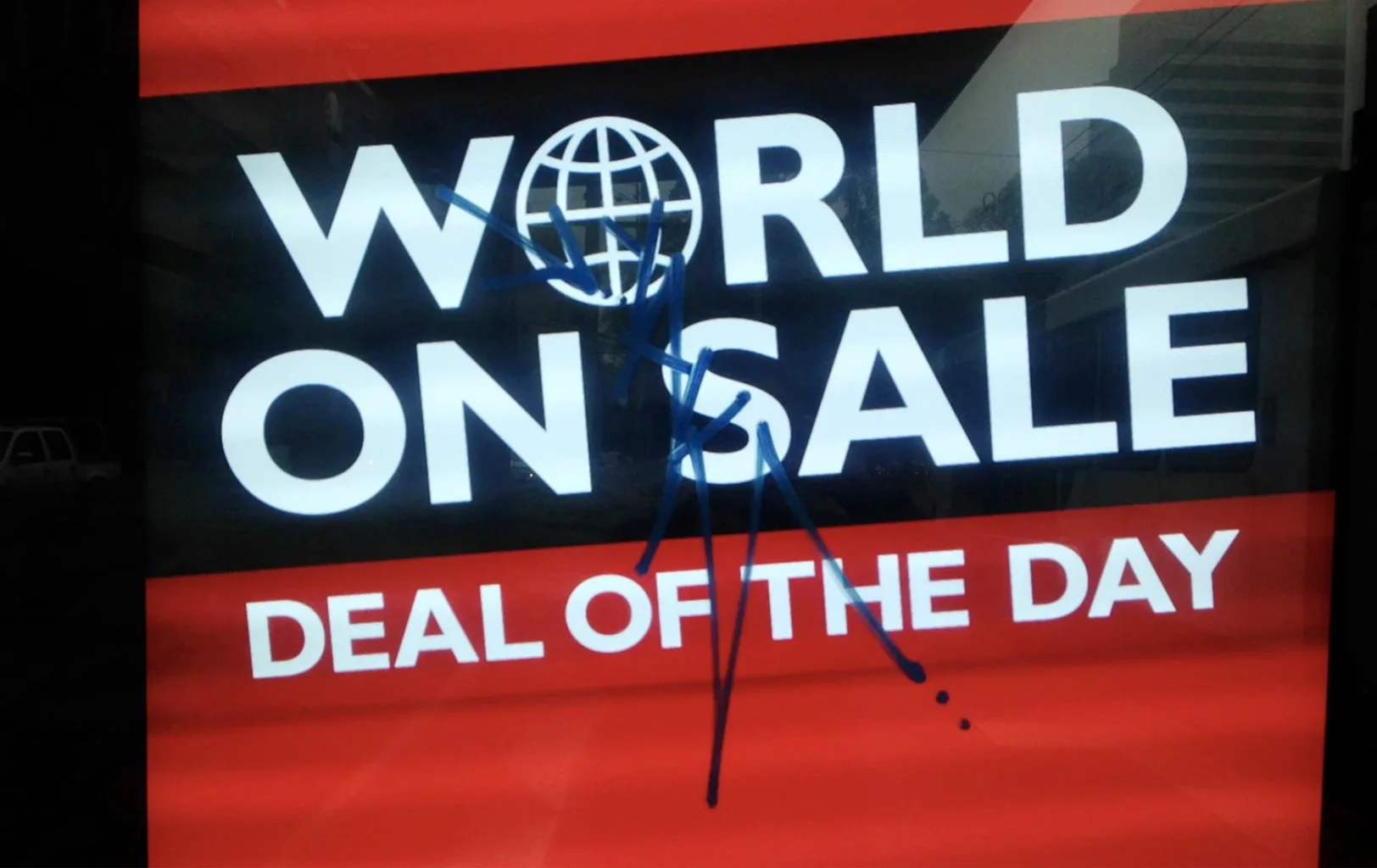
The World on Sale, Bus-stop advertisement (detail) Melbourne, Australia, 2016 Source: ©Tommaso Durante/The Visual Archive Project of the Global Imaginary
Methodological Framework
Tommaso Durante contends that the cultural shifts we are undergoing should be examined through global theoretical frameworks, transdisciplinary approaches, new thinking tools, and a method of critical visual analysis he calls "global iconology." He broadens the "iconological" method used in art history — developed by Warburg, Panofsky, Gombrich, and W.J.T Mitchell — to go beyond analysing individual artworks and artists' imaginaries, towards examining social phenomena and collective imaginaries. The method involves three progressive levels of analysis: pre-iconographic description, iconographic interpretation, and iconological synthesis — each building on the last until the image's ideological role within the global imaginary is fully revealed.
Level One: Pre-Iconographic Description
At its most immediate, the image shows a Bus Stop commercial display produced by Flight Centre, photographed in Melbourne. The dominant visual field is divided into two horizontal bands: a black upper section bearing the words "WORLD ON SALE" in large white sans-serif capitals, accompanied by a white line-drawing of a globe, and a red lower band with "DEAL OF THE DAY" in the same bold typographic register. A crude blue stick figure — drawn directly on the glass — overlaps both zones of text, its body bisected by the globe icon, its limbs extending downward across the red band. The stick figure appears to have been drawn after the commercial signage was installed, not as part of the original design. The colour palette is stark and binary: commercial red and black against white lettering, interrupted by the informal, almost childlike blue marker lines.
The composition creates a strong sense of hierarchy and scale: the globe is used as a letterform substitution (for the letter "O" in "WORLD"), and the stick figure is formally subordinate but spatially dominant — it occupies the centre of the frame and cuts across both textual zones.
Level Two: Iconographic Analysis
At this level, we identify the conventional meanings and symbolic registers at play.
The Globe as a “visual ideological marker of globality”.
Durante identifies a particular type of image he calls "ideological markers of globality" — images that condense many layers of meaning and, crucially, compress the spatial-symbolic scales of the local, national, and global into one single visual formation or event. The globe icon embedded in "WORLD ON SALE" is a textbook example: it simultaneously functions as a letter, a brand marker, a cosmopolitan aspiration, and an ideological claim. It does not merely represent the world — it recruits the world as a sales proposition.
"World on Sale" as Market Globalism. The phrase is not metaphorical in an innocent sense. It enacts what Theodore Lewitt (1983) and Manfred Steger identify as market globalism — the dominant ideology of globalisation that naturalises the commodification of all social and geographical space. Durante's research argues that the cultural and visual-ideological aspects of globalization are of equal significance to its economic dimensions, and that the "global" has the symbolic power to transform urban spaces by creating the global imaginary in a single place. Here, the bust stop advertisement achieves exactly this: a local Melbourne retail space absorbs the entire globe into its discount logic.
The Stick Figure as Interruptive Counter-Sign. The stick figure is the critical dissonance in the image. Iconographically, it reads as a human being — the universal shorthand for personhood, deployed in signage, emergency exits, and children's drawings. Its placement directly over the globe symbol is not accidental in its effect, even if unplanned in its execution: the figure appears to be wearing the globe as a head, produced by it, or crucified upon it. The spindly, improvised quality of the mark contrasts sharply with the polished professionalism of the commercial typography. It introduces a handmade, resistant, or at the very least humanising interruption into the market-globalist visual field.
Level Three: Iconological Synthesis — The Image as Political Theory
This is the level at which Durante's method most powerfully diverges from conventional art-historical iconology. During focuses on the emerging visual-discursive epistemic regime of the global, examining how global subjectivities are symbolically and socially constructed at local scale, under present conditions of globalization. The visual images in his archive were selected on the basis of their categorisation as "visual ideological markers of globality," which he argues are effective keys to advancing understanding of globalization as both a material and ideational process.
Viewed through this lens, the image becomes dense with ideological content.
The World as Commodity.
The phrase "WORLD ON SALE" is one of the most literal possible expressions of what critical theorists from Marx to David Harvey have identified as the logic of capital: the conversion of all life, space, and social relation into exchangeable commodities. What is remarkable here is that this logic is not hidden or euphemised — it is the advertisement itself. The store does not offer a product from the world; it offers the world as the product, flattened into a "Deal of the Day," which implies ephemerality, abundance, and disposability. The world is not precious or singular — it is on rotation, available today, perhaps replaced tomorrow.
The Globe Icon and Visual Ideology.
Durante's visual archive shows how advertisements and promotional imagery that deliberately use the globe or words like "global" and "international" produce a sense of shared meaning and influence cultural identities. The globe-as-O is a particularly efficient condensation: it naturalises the claim that commerce is universal, that the market is as total and self-evident as the spherical world itself. There is no outside to this proposition; the globe is complete, contained, bordered — and yet it is also, in this image, available for purchase.
The Stick Figure: Resistance, Alienation, or Complicity?
This is the most critically productive element for global iconological analysis. The stick figure introduces ambiguity that the commercial sign would otherwise foreclose. Several readings are possible, and Durante's method — which draws on both semiotics and social theory — encourages holding them in tension rather than resolving them.
First, the figure may represent counter-symbolic intervention — a form of visual dissent, the mark of someone who recognised the ideological operation of the sign and chose to annotate, disrupt, or mock it. The crudeness of the mark against the slickness of the commercial text is itself a political contrast. If we follow Durante's interest in globalised spatial practices of resistance, this is an act of what he calls the visual politics of the street.
Second, the figure may represent the human subject produced by market globalism itself — a person who, under the global imaginary, is interpellated as a consumer rather than a citizen, and whose identity is literally constituted by the commodity form. The figure stands inside the frame of the advertisement, not outside it; it does not escape the sign but inhabits it.
Third, the globe as the stick figure's head is iconographically charged: the world thinks for the human, and the global imaginary replaces individual subjectivity. This resonates with Durante's concern that market globalism operates at the level of consciousness — shaping not just behaviour, but identity, desire, and what counts as common sense (the common sense of the global).
The Urban and Online Space as Ideological Site.
Durante's Visual Research Project of the Global Imaginary investigates how symbols found in the urban spaces of global and fast globalising cities and the different materiality of the social web (offline and online) construct a new social imaginary that is simultaneously local, national, and global. Melbourne — the city in which this image was photographed — is itself one of Durante's primary field sites. The shopfront window is precisely the kind of everyday urban surface that, in his framework, does not merely reflect the global imaginary but actively produces it in daily life. The passerby who reads this sign is being invited to inhabit a world in which the planet is a marketplace, commerce is cosmopolitan, and buying is belonging.
Durante's research identifies how the circulation of particular types of socio-historically, ideologically, and emotionally charged global images is creating a new aesthetic and affective landscape. This image, with its red-black-white urgency, it’s imperative typographic mode, and its globe-as-commodity proposition, is precisely such a landscape: it aestheticizes market globalism, making it feel natural, exciting, even playful. The "Deal of the Day" framing borrows from digital e-commerce culture and the vocabulary of algorithmic retail — an infinite stream of offers, rotating endlessly, each one as universally available as the next.
Level Four: The Ideologeme
Tommaso Durante's concept of the “ideologeme” — derived from his work on media discourse and semiotics — refers to the smallest unit of ideology embedded within a text or image, a condensed sign that conveys and naturalises a broader ideological framework. In this image, the dominant ideologeme is the phrase "World on Sale," which combines the whole globe (represented by the planetary icon replacing the letter "O") with the logic of commodity exchange. The world is not just a backdrop for commerce; it is the commodity. This blurs the line between life, nature, politics, and the market into a single, upbeat retail message. The red-and-black colour scheme — urgent, aggressive, carnival-like — further grounds the message within the grammar of advertising urgency, making it seem natural that everything, at any scale, is available for purchase if the timing is right.
What makes this image especially rich for ideologeme analysis is the blue stick figure drawn (or scratched) onto the glass in front of the sign. This mark acts as a counter-ideologeme — a spontaneous, amateur gesture that breaks up the seamless ideological surface. The stick figure stands inside the sign, arms outstretched, almost cruciform, precisely over the globe icon. Whether intentional or not, this intervention introduces a human body into a discourse that has completely erased the human: the "World on Sale" sign has no people, only markets. The graffiti-like figure thus performs a small act of re-humanisation — or perhaps ironic self-insertion — making the underlying ideological violence of the sign visible by contrast. In Durante's terms, the ideologeme only becomes understandable as ideology when something interrupts its smooth operation, and here the stick figure does exactly that.
Concluding Remarks
What this image ultimately reveals, through the lens of Durante's global iconology, is the ideological completeness of market globalism as a visual proposition. The world is not just a backdrop for commerce — it has been absorbed into commerce, rendered as a typographic element, placed on sale, reduced to a daily deal. In Durante's terms, this is part of the visual-ideological apparatus of globalization.
The stick figure is what saves the image from being merely illustrative. It introduces an element of uncertainty — a body that was not planned, a mark made by a person rather than a corporation, a line that trembles and drips rather than printing cleanly. It is, in Durante's spirit, the image offering a glimpse of the human subject that market globalism both requires and threatens to erase. Whether that figure is resisting the sign, trapped within it, or simply playing — the ambiguity is itself the political message. Global iconology, as a method, does not resolve such ambiguity. It dwells in it, because it is there, in the tension between the polished globe and the fragile stick figure, that the ideology of our present condition becomes visible.